Our research proposal, entitled “Co-Creating Sustainable Agriculture: Upscaling Crop Rotation and Biodiversity at the Farm Level through Living Labs and Digital Technologies (CropRotaM),” which we submitted to the PRIMA Section-2 Call, has been selected by the Scientific Evaluation Committee and will be funded by national funding organizations.
Objectives and Ambition:
Agriculture in the Mediterranean faces urgent challenges of soil degradation, biodiversity loss, and climate vulnerability. Small-scale farmers need viable agroecological solutions that maintain productivity while enhancing resilience. CropRotaM’s overall aim is to upscale agroecology at the farm level across the Mediterranean by codeveloping and validating innovative cropping systems, tools, and business models. This will demonstrate that diversified rotations, “living soil” inputs, and smart farming technologies can deliver both environmental restoration and socio-economic gains, aligning with PRIMA’s mission. Ultimately, the project will serve as a demoscale proof-of-concept that agroecological intensification can simultaneously improve climate adaptation, biodiversity, and farmer livelihoods, paving the way for broader replication in the region
Methodology
CropRotaM’s methodology is designed to upscale agroecology at farm level through a network of multiactor Living Labs across the Mediterranean and Europe. CropRotaM’s approach is grounded in the principles of agroecologym“a holistic and integrated approach that simultaneously applies ecological and social concepts and principles to the design and management of sustainable agriculture and food systems”1. This means optimizing interactions between crops, soil, water, and farming communities to regenerate ecosystems while sustaining productivity. The project will create transdisciplinary Living Labs where farmers, scientists, advisors and SMEs co-create Agroecological Innovation Packages (AIPs) tailored to local conditions.
List of participants
| # | Participating Organisation Legal Name | Participant Acronym | Country | Type of the Organisation |
| 1 | ARTECS Anadolu ARGE ve Tekno.A.Ş. | AR&TeCS | Turkiye | SME |
| 2 | University Of Hohenheim | UHOH | Germany | University |
| 3 | University Of Basilicata | UNIBAS | Italy | University |
| 4 | Centro de Edafología y Biología Aplicada del Segura
|
Cebas-Csic. | Spain | Research Institute |
| 5 | Polytechneio Kritis | TUC | Greece | Public Law Body – University |
| 6 | Italian Council For Agricultural Research And Economics | CREA | Italy | Research Institute |
| 7 | Soil, Fertilizer And Water Resources Central Research Institute, | SFWRCRI | Turkiye | Research Institute |
| 8 | Centre of Biotechnology of Borj-Cedria, Laboratory of Extremophile Plants | CBBC | Tunisia | Research Institute |
| 9 | Agreenment srl | AGM | Italy | SME |
| 10 | e.RATIO srl | ERA | Italy | SME |
| 11 | SINGLE MEMBER P.C. REFARM | Refarm | Greece | SME |
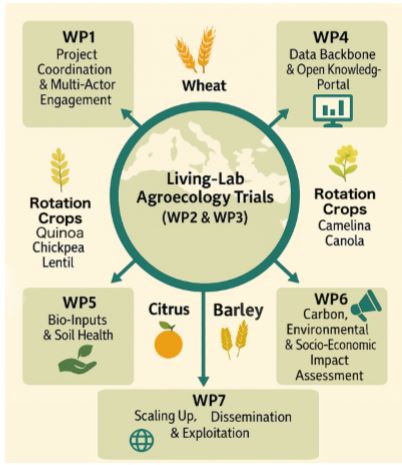
Work Plan Overview
WP1: Project Coordination and Multi-Actor Engagement (Lead: AR&TeCS).
WP2: Co-Design of Agroecological Practices via Living Labs (Lead: UNIBAS & CREA-PB).
WP3: Agroecological Field Trials and Performance Assessment (Lead: UHOH).
WP4: Data Backbone & Open Knowledge Portal (Lead: AR&TeCS).
WP5: Bio-Based Inputs and Circular Amendments for Resilient Soils (Lead:CEBAS).
WP6: Carbon, Environmental and Socio-Economic Impact Assessment (Lead: TUC).
WP7: Scaling Up, Communication, Dissemination, and Exploitation (Lead: REFARM).